


Rewriting the Classics: What Modern Adaptations Reveal About Us
How Film Transforms the Worlds of Classic Literature
Adaptation: the process of taking an existing work and translating it into a completely new medium — the art of creating something original, while remaining familiar to an audience. However, the role of adaptation is not to replicate, but to interpret. Interpretations are products of their time. They evolve as new contexts come to light, and as the interpreter utilises different methodologies, emphasises unique elements, and centres on fresh ideas or questions. Because adaptations are inherently subjective interpretations of a source text, audiences from contrasting cultural backgrounds will naturally decode and respond to these cinematic or literary re-imaginings in vastly different ways.
Yet, amidst this variance, generic interpretations do exist. Audiences can interpret a work strictly through the lens of its genre, focusing on significant tropes, treating the details as formulaic standards, and aligning the narrative with their own expectations. Ultimately, the distinction between creators and directors stems from numerous factors: the historical context of production, the thematic focus, the questions being addressed, the creator’s background, available evidence, ideological arguments, and differing conceptual definitions.

In Joe Wright’s 2005 adaptation of Pride and Prejudice, the romance is famously built primarily on hand-flexes, yearning glances, and unspoken tension. This masterpiece perfectly captured the mid-2000s obsession with "clean" romantic idealism. This shift was driven by a post-9/11 desire for pure escapism, a growing media backlash against increasingly graphic modern media, and the wholesome influence of classic 2000s rom-coms.
This yearning dominated pop culture through multiple channels, including the rise of purity culture promoted by religious movements, chick-lit novels blending female empowerment with clean desire, and directors prioritising sharp, witty banter over explicit scenes. Joe Wright cannot show Darcy and Elizabeth touching intimately because of the Regency setting, so he uses heightened sensory details to show that their physical restriction amplifies their desire. For example, the infamous hand flex shows that the brief touch of her skin was an absolute electric shock to his system. The single camera choice reveals that in a repressed society, the smallest touch becomes hyper-charged. Wright echoes this sensory tension during the rainstorm scene, at Darcy’s first disastrous proposal at the Temple of Apollo. Wright shoots them in tight, claustrophobic close-ups. They are arguing, though the camera frames them as if they are about to kiss. By withholding any intimacy, Wright creates anticipation, revealing society’s modern romantic obsession with the agony of longing.

On the other hand, Laure de Clermont-Tonnerre’s 2022 adaptation of Lady Chatterley’s Lover leans entirely into the raw, unrestrained physical connection. By doing the exact opposite, she portrays physical intimacy as a radical, life-saving act of rebellion against the cold industrial world of the 1920s. The post-WW1 setting is captured through period costumes and backdrop, but filtered through a modern lens, contrasting traditional historical grimness with contemporary ideals of romantic liberation. Through direction, Clermont-Tonnerre uses static, rigid camera angles and cold, blue, washed-out lighting. However, when Connie goes to her lover’s hut in the woods, the lighting shifts to warm, golden sunbeams, and the camera becomes more fluid. This cinematography shows the links between sexual awakening and natural freedom. Intimacy isn’t treated as scandalous; the visual style frames it as pure and liberating. Where Wright aestheticises restraint, Clermont-Tonnerre aestheticises release.

Destructive, toxic relationships are depicted through obsession and taboo in Emerald Fennell’s Wuthering Heights (2026). Emily Brontë’s gothic masterpiece is heavily modernised in this adaptation, using a lurid, heightened style. Fennell leans into the characters’ cruelty, physical needs, and toxic codependency. She does this through hyper-visceral production design and body-centred directing. Fennell exchanges traditional period accuracy for a surrealist, provocative environment that visually acts out the characters’ inner sickness. For example, the ‘skin’ room depicts body horror as decor, showing how Edgar Linton has essentially built a prison out of Cathy’s skin. This visually proves that in this adaptation, love is claustrophobic, centred on bodily consumption. Furthermore, instead of showing characters suffering in quiet, internal agony, Fennell modernises their cruelty through explicit physical acts, revealing a highly modern preoccupation with psychological trauma loops. Fennell shifts the narrative from a tragic gothic fate to an active destruction, utilising a modern lens of ‘toxic relationships’ where pain and pleasure are entirely blurred. This exposes modern society’s current obsession with psychological toxicity and trauma. Instead of viewing Heathcliff and Cathy as tragic soulmates, the 2026 adaptation acknowledges that modern society is fascinated by the hidden depravity of human nature, showing how trauma loops people into mutually destructive cycles.
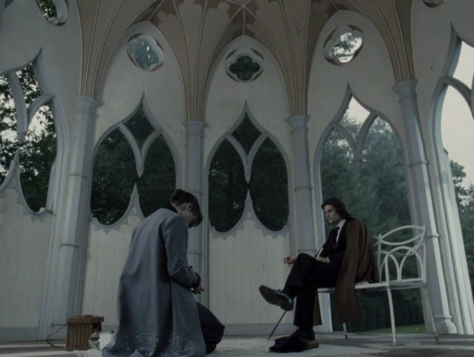
The 2009 adaptation of The Picture of Dorian Gray directed by Oliver Parker reveals the aestheticism and moral decay found within Wilde’s infamous novel. This cinematic version, however, increases the hedonism, vanity, and visual excess by effectively ‘splattering’ the sins across our screens. Where Wilde only implied Dorian’s sins to avoid Victorian censorship, Parker plunges into the deep end to satisfy a modern audience’s appetite for visual excess.
Lord Henry, in both novel and film, is perceived as a toxic influencer. In the novel, he is an intellectual philosopher who manipulates Dorian with clever dialogue, whereas in the film, Colin Firth plays him with a much darker, predatory edge, by dragging Dorian into the dark, smoke-filled, drug-fueled underbelly of Victorian London. He acts as a literal dealer of vice, introducing Dorian to opium dens, prostitution, and self-indulgence. By making Lord Henry actively orchestrate Dorian’s corruption, the film recasts him as a proto-influencer. He sells a toxic lifestyle of consequence-free vanity that mirrors modern consumerism and internet celebrity culture. Furthermore, Parker literalises Dorian’s spiritual degradation by transforming the iconic painting into a living, breathing monster. The portrait actively rots and bleeds with age, dripping with black tar and a swarm of maggots and flies. The film adds a shocking layer of body horror by showing the canvas physically groaning and bleeding when stabbed. This visual overload forces the audience to confront the physical consequences of moral decay. It transforms Wilde’s elegant philosophical warning about the soul into a loud, visceral horror show of spiritual self-destruction.
Modern adaptations are inherently subjective interpretations that utilise the codes of genre to make historical narratives legible today. Ultimately, these cinematic re-imaginings prove that classic literature is not a fixed monument, but a fluid canvas for contemporary interpretation. This evolution is traceably marked by a cultural shift from the repressed, ‘clean’ romantic idealism of Joe Wright’s Pride and Prejudice to the raw, liberating physical connection of Laure de Clermont-Tonnerre’s 2022 Lady Chatterley’s Lover. Furthermore, contemporary psychology and digital culture have radically reframed these narratives, with Emerald Fennell’s 2026 Wuthering Heights exposing modern anxieties regarding trauma loops, and Oliver Parker’s 2009 Dorian Gray confronting our obsession with consumerism and influencer culture. Ultimately, when creators rewrite the classics, they are not attempting to alter the past. Instead, they are holding up a mirror to our current socio-cultural anxieties, fears, and values, proving that we re-read history only to better understand ourselves.
Comments